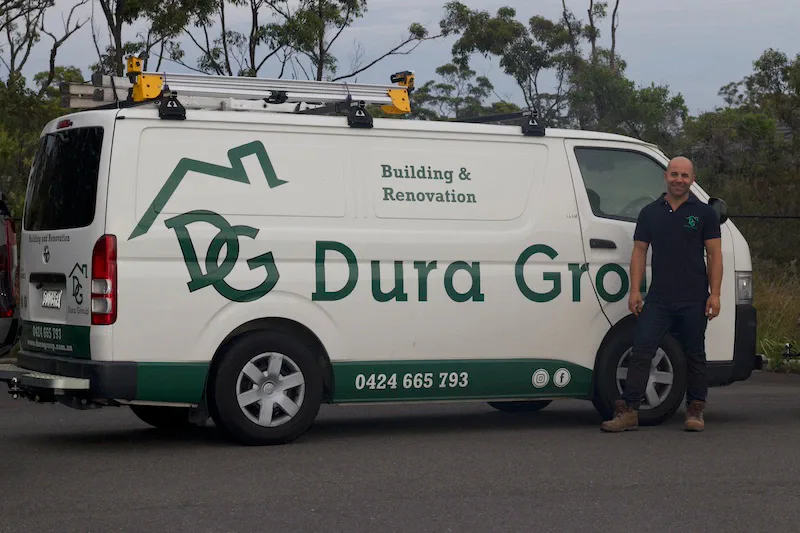
An owner builder permit is a licence issued by NSW Fair Trading that allows a homeowner to manage or coordinate residential building work on their own property without hiring a licensed builder as the principal contractor. The permit does not mean you do all the work yourself. It means you take on the legal responsibilities that a licensed builder would normally carry, including coordinating trades, managing timelines, and meeting compliance obligations under the Home Building Act 1989.
At Dura Group Building & Renovations, we do not discourage owner-building. Some homeowners have the skills, time, and temperament to manage a project well. But the permit comes with obligations that many people underestimate. This guide covers exactly what is involved so you can make an informed decision.
When do you need an owner builder permit in NSW?
You need an owner builder permit for any residential building work on your own property valued at over $10,000 (including labour and materials). This applies to renovations, extensions, new builds, swimming pools, retaining walls, and structural alterations. Work under $10,000 does not require the permit, though council approval may still be needed depending on the scope.
Examples of work that triggers the permit requirement:
- A bathroom renovation with a total cost of $35,000
- A rear ground-floor extension valued at $180,000
- A new carport or garage costing $15,000
- Kitchen and living area structural modifications totalling $60,000
If your project requires a Development Application or Complying Development Certificate, the owner builder permit is a separate requirement on top of that. Understanding the difference between DA vs CDC approvals will help you plan the right sequence of paperwork before any work starts.
How do you apply for an owner builder permit?
You apply through NSW Fair Trading, either online or by visiting a Service NSW centre in person. The application costs approximately $137 (as of 2025) and the permit is valid for the duration of the project.
The application process involves 3 steps:
- Complete an approved owner builder course before applying (we cover this in the next section)
- Submit your application through the NSW Fair Trading online portal, including your course completion certificate, property details, and a description of the proposed work
- Receive your permit, which must be displayed on site once work begins
You can only hold one owner builder permit at a time. If you already have an active permit on another property, your new application will be refused until the existing project is completed or the permit is cancelled.
What is the owner builder course requirement?
Before you can apply for an owner builder permit, you must complete a NSW-approved owner builder course that covers contract management, building regulations, workplace safety, and insurance obligations. The course is delivered by registered training organisations and typically takes 1 to 2 days to complete. Some providers offer it online.
The course certificate is valid for 5 years. After that period, you would need to complete the course again if you wanted a new permit. Topics covered include:
- Your legal obligations under the Home Building Act 1989
- How to engage and manage licensed tradespeople
- Workplace health and safety requirements on residential building sites
- Contract administration, including progress payments and dispute resolution
- Insurance and warranty responsibilities
The course gives you foundational knowledge, but it does not replace hands-on building experience. Many owner builders find that the real challenges start once work is underway, not in the classroom.
What insurance do owner builders need?
Owner builders are not covered by the Home Building Compensation Fund (HBCF) and must arrange their own insurance, including workers compensation and public liability cover. This is one of the biggest differences between owner-building and using a licensed builder. When you hire a licensed builder for work over $20,000, they are legally required to provide HBCF insurance that protects you if they die, disappear, or become insolvent. As an owner builder, that safety net does not exist.
Here are the 3 insurance types owner builders should consider:
- Workers compensation insurance: Required by law if you engage any workers, including subcontractors in some cases. Fines apply if workers are injured on your site and you do not hold a current policy.
- Public liability insurance: Covers injury to third parties or damage to neighbouring properties during construction. A standard policy of $10 million to $20 million is common for residential projects.
- Contract works insurance: Covers the project itself against damage from storms, fire, theft, or vandalism during construction. Your standard home insurance usually excludes building work in progress.
The cost of these policies varies depending on the project value and scope. Budget between $2,000 and $5,000 for a mid-sized renovation. This is an expense that licensed builders absorb into their overheads, so it is often invisible to homeowners until they manage the project themselves. Our article on hidden renovation costs covers other expenses that catch homeowners off guard.
What can you do as an owner builder?
An owner builder can do most general building work themselves, including carpentry, painting, tiling, landscaping, and demolition, but licensed trades must be used for plumbing, electrical, gas fitting, and waterproofing. This is a non-negotiable requirement under NSW law. Unlicensed plumbing or electrical work is illegal regardless of who owns the property.
Work you can do yourself:
- Demolition and site preparation
- Framing and carpentry (if you have the skill)
- Plastering, painting, and decorating
- Tiling floors and walls
- Landscaping and fencing
- Installing cabinetry and joinery
Work that requires a licensed tradesperson:
- Plumbing and drainage: Must hold a plumbing licence and issue a Certificate of Compliance
- Electrical work: Must hold an electrical licence and issue a Certificate of Compliance
- Gas fitting: Must hold a gas fitting licence
- Waterproofing: Must hold a waterproofing licence for wet areas such as bathrooms, laundries, and showers
Even for work you are legally allowed to do, quality matters. A certifier will inspect the work at key stages, and substandard framing, tiling, or plastering can lead to failed inspections and costly rework.
What are the restrictions on selling after owner-building?
If you sell your property within 6 years of completing owner-builder work, you must provide the buyer with a certificate of insurance or take on full personal warranty liability for defects. This is one of the most commonly misunderstood aspects of owner-building in NSW.
Here is how the warranty obligations break down:
- Major defects: You are personally liable for 6 years from the date of completion. Major defects include structural cracking, foundation movement, and waterproofing failure.
- Minor defects: You are personally liable for 2 years from the date of completion. Minor defects include cosmetic issues, paint defects, and small tiling problems.
Unlike a licensed builder who provides HBCF insurance, an owner builder’s warranty is backed by nothing more than their personal finances. If the buyer discovers a major structural defect 4 years after purchase, they can pursue you personally through the NSW Civil and Administrative Tribunal (NCAT) for the cost of rectification.
You are also legally required to disclose your owner builder status to any buyer and provide them with a copy of the owner builder permit. Failing to disclose this information can result in the contract being voided or additional legal claims against you. Before undertaking major work, it is worth reading a building contract to understand how warranty clauses typically work with licensed builders.
What are the real risks of owner-building?
The 3 biggest risks are cost blowouts, scheduling delays, and quality issues, all of which stem from the same root cause: managing a building project requires daily coordination experience that most homeowners do not have.
Cost blowouts. Licensed builders negotiate trade and material rates based on volume relationships built over years. An owner builder typically pays retail prices. On a $200,000 renovation, the difference can be $20,000 to $40,000 in material costs alone. Add rework from sequencing errors and the savings you expected from cutting out the builder’s margin can vanish entirely.
Scheduling delays. Building trades work in a specific sequence. Plumbers rough in before plasterers line walls. Electricians wire before insulation goes in. Waterproofers need a specific window before tilers start. A licensed builder coordinates this sequence across 8 to 12 different trades on a typical renovation. One trade running late creates a chain reaction. Without established relationships and scheduling systems, owner builders frequently lose weeks to trade availability gaps.
Quality issues. Experienced builders inspect work at every stage and know what to look for. They catch problems before they get built over, such as incorrect falls on a shower floor, insufficient noggins for heavy fixtures, or flashing details that will leak in 2 years. An owner builder may not recognise these issues until they cause damage down the track.
None of these risks are guarantees of failure. Some owner builders manage projects well and achieve good results, particularly on simpler scopes. But the risks increase with project size and complexity. A bathroom is more forgivable than a full first-floor addition.
How does owner-building compare to using a licensed builder?
The key differences come down to risk allocation, insurance protection, trade coordination, and warranty coverage. The following comparison covers the main areas where the two approaches differ.
| Factor | Owner builder | Licensed builder |
|---|---|---|
| Permit required | Owner builder permit for work over $10,000 | Builder holds their own licence |
| HBCF insurance | Not available | Required for work over $20,000 |
| Workers compensation | Owner builder must arrange and pay | Builder provides as part of their licence obligations |
| Public liability | Owner builder must arrange and pay | Builder carries their own policy |
| Trade coordination | Owner builder manages all scheduling | Builder coordinates all trades |
| Quality oversight | Owner builder inspects work | Builder inspects at each stage |
| Warranty on sale | Personal liability for 6 years (major) and 2 years (minor) | HBCF insurance covers buyer |
| Material pricing | Retail rates in most cases | Trade pricing through established supplier accounts |
| Dispute resolution | Owner deals directly with each trade | Single point of contact with builder |
| Potential cost savings | Possible on small, simple projects | Often comparable or lower due to trade pricing and fewer errors |
For smaller projects with a straightforward scope, owner-building can work. For anything involving structural changes, multiple wet areas, or work valued over $100,000, the coordination demands increase sharply. Many homeowners who start as owner builders on large projects end up engaging a licensed builder partway through after experiencing delays and cost overruns.
What should you consider before applying for an owner builder permit?
Ask yourself 5 honest questions before committing to owner-building:
- Do you have the time? Managing a renovation is not a weekend task. Expect to spend 10 to 20 hours per week on coordination, site visits, supplier orders, and problem-solving during active construction.
- Do you have trade contacts? A licensed builder has relationships with reliable plumbers, electricians, carpenters, and tilers. As an owner builder, you need to source, vet, and manage each trade yourself. Performing a builder licence check in NSW is one way to verify trade credentials before engaging anyone.
- Can you manage the financial risk? Without fixed lump sum pricing, your budget is an estimate. Variations, rework, and trade availability all affect the final cost.
- Are you planning to sell within 6 years? The personal warranty obligation is a serious financial exposure. If there is any chance you will sell in that window, factor in the cost of potential defect claims.
- Is the scope within your capability? Painting a house is different from managing a structural extension with engineering, council approvals, and 12 trades. Be realistic about what you can coordinate.
If you are unsure about the approval pathway your project needs, a planning review service can clarify whether you need a DA, a CDC, or both before you commit to the owner builder route.
How can Dura Group help if you decide not to owner-build?
Dura Group provides full project management from planning through to handover, including trade coordination, council approvals, HBCF insurance, and fixed lump sum pricing with no hidden costs. We handle DA approval services for projects that need council consent, and our professional home renovation process is designed to remove the coordination burden entirely.
Mark personally oversees every project. Our trades are long-standing partners we have worked with across hundreds of renovations over 25 years. Materials and trades are locked in before work starts, so there are no delays waiting on availability. If you are weighing up whether to manage the job yourself or bring in a licensed builder, our guide on choosing a builder covers what to look for and what questions to ask.
We also offer Dura Group renovation services that cover everything from bathroom and kitchen renovations to full home extensions, all under one contract with one point of accountability.
Not sure if owner-building is right for you?
Owner-building suits some homeowners, but it carries real responsibility. Contact Dura Group for a consultation. We can discuss your project scope and help you decide whether managing it yourself or using a licensed builder is the better path.
Dura Group serves homeowners across the Sutherland Shire, the Georges River area, Mortdale, builders in Jannali, and Port Hacking home builders.

Mark Dura is the founder of Dura Group Building & Renovations, a licensed builder (Lic 381531C) with 27+ years of experience in residential renovations, home extensions, and knockdown rebuilds across Sydney. Mark oversees every project from design through to completion.