A rear extension is the most practical way to add usable living space to a Sydney home without touching the street frontage. For terraces in Marrickville and Newtown, and bungalows across Oatley and Hurstville Grove, the rear is often the only direction a home can grow. This guide covers everything you need to know: design, structure, approvals, and what drives the cost.
What is a rear extension, and why is it so common in Sydney?
A rear extension is a ground-level addition built onto the back of a home, typically replacing or enclosing an existing outdoor or covered area. In Sydney’s Inner West, it is by far the most common extension type. Terraces in Erskineville, Leichhardt, and Newtown sit on narrow lots with boundary walls on both sides. They cannot extend sideways and heritage overlays usually protect the front facade, leaving the rear as the only available direction for growth.
The same applies across the Georges River area. Older homes in Oatley and Hurstville Grove were often built with detached laundries, fibro rear rooms, or outdoor sleepouts. Replacing or enclosing those structures with a properly designed rear extension transforms the entire ground floor.
If you are comparing your options at the ground level, our Ground Floor Extension Guide covers the full range of horizontal additions, of which the rear extension is one specific type.
What design decisions matter most in a rear extension?
The three decisions that shape a rear extension are orientation, the indoor-to-outdoor connection, and the program of rooms you place at the rear. Get these right and the extension works beautifully for decades. Get them wrong and you end up with a dark, disconnected room that adds floor area but not liveability.
How do you make the most of north-facing light?
Most Sydney lots that face the street to the east or west will have a north-facing rear, which is ideal for capturing winter sun through glazing. We design rear extensions to take full advantage of this. Large north-facing windows and sliding or stacking doors draw in natural light through autumn and winter, reducing reliance on artificial lighting and heating. Where the rear faces south, skylights and high-level clerestory windows become important tools for bringing light into the space.
On terraces, the party walls on both sides mean that almost all natural light must come from the rear glazing or from a roof light over the kitchen zone. Getting the window and door configuration right at the design stage is not something that can easily be corrected later.
What rooms typically go in a rear extension?
The kitchen and open-plan living area is the most common program for a rear extension, and it works particularly well because it places the most-used rooms at the brightest and most connected part of the home. A typical rear extension in Marrickville or Leichhardt will involve removing the existing rear rooms, pushing the kitchen toward the back, opening it to a dining and lounge space, and framing the whole thing with large sliding doors onto the outdoor area.
Three common configurations we see in Inner West terraces and bungalows are:
- Kitchen, dining, and lounge in an open plan, with a covered deck beyond the doors
- Kitchen at the rear with a butler’s pantry or laundry embedded in the extension footprint
- A family room extension added behind an existing kitchen that is retained in its current position
How do you connect the extension to the outdoor area without losing the yard?
The key is setting the rear building line so that you retain a usable outdoor zone between the extension and the rear boundary. Most homeowners want a covered deck or alfresco area immediately outside the doors, then a lawn or garden beyond that. We work through the setback rules with you at the design stage so the extension footprint is sized to leave meaningful outdoor space, not just a thin strip.
For terraces on smaller lots in Newtown or Erskineville, this sometimes means the extension is shallower than the homeowner first imagined. A 4-metre deep extension that leaves 4 metres of yard is almost always better than a 7-metre deep extension that leaves 1 metre of concrete.
What structural considerations apply to rear extensions?
The structural complexity of a rear extension depends on what exists at the rear of the home, the condition of the existing foundations, and whether you share a boundary wall with a neighbour. In Sydney’s Inner West, two issues come up on almost every project: party wall conditions and sub-floor access.
What happens with party walls in terrace extensions?
A party wall is a shared structural wall on the boundary between two terrace properties, and any work that touches it requires careful management. If your rear extension runs up to the boundary, the party wall may need to be tied into, built against, or partially modified. This is governed by the relevant provisions of the Building Code of Australia and, depending on the council and the scope of work, may require a party wall agreement with the adjoining owner.
We have completed rear extensions on terraces across Marrickville, Leichhardt, and Newtown where the party walls were load-bearing or in poor condition. In those cases, we bring in a structural engineer early to assess the wall, specify any underpinning or tie-in requirements, and document the agreement with the neighbour before work begins. This protects both parties and avoids disputes during construction.
Does a rear extension require underpinning?
Underpinning is sometimes required when the new extension footings need to be deeper than the existing footings, or when excavation for a slab is close to an existing footing that sits at a shallower depth. This comes up most often on terrace homes in the Inner West, where the original foundations were built in the Federation or interwar period and may sit only 300 to 450mm below the surface.
If the new slab is being poured at a lower level, or if the extension sits very close to the existing structure, a structural engineer will determine whether underpinning is needed and specify the method. It adds cost and time, but it is a non-negotiable safety requirement on those sites. We assess this at the quoting stage so there are no surprises mid-project.
What about site access on tight Inner West blocks?
Access to the rear of a terrace is almost always through the house or through a narrow side passage, which affects how materials are delivered and how waste is removed. On a freestanding bungalow in Haberfield or Leichhardt, there may be a side gate wide enough for a small excavator or concrete pump. On a mid-terrace in Newtown or Erskineville, everything goes through the front door and through the home.
We plan access carefully before the project starts. This affects the excavation method, the concrete pour strategy, and the sequencing of materials deliveries. It is one of the reasons that rear extension projects in dense terrace streets take slightly longer than equivalent work on freestanding homes, and it is factored into our project schedule from the start.
Do I need Council approval for a rear extension?
Many rear extensions in Sydney can be approved under the Complying Development Certificate pathway, which is faster and avoids a full Council DA process. To qualify, the extension must meet the relevant State Environmental Planning Policy (the Exempt and Complying Development Codes SEPP), including setbacks, maximum height, and total floor area limits relative to the existing dwelling.
Our full breakdown of both pathways is in our guide on CDC application process, but here is the practical summary for rear extensions:
- CDC is often available for rear extensions on non-heritage-listed properties, where the site meets the standard instrument LEP requirements
- A full DA is required if the property is heritage-listed, if the rear extension exceeds the complying development size limits, or if the site has specific overlays that require assessment
- Rear extensions are generally less restricted than front additions because they do not affect the heritage streetscape
In the Inner West, many Federation and interwar terraces are listed on the heritage register or sit within a heritage conservation area. This does not automatically prevent a rear extension, but it does mean the rear addition must be designed sympathetically and, in most cases, requires a DA rather than a CDC. Our Heritage Renovation Sydney page covers how we approach those projects.
For homeowners in the Inner West, our guide to Renovating in the Inner West covers the council-specific requirements and heritage considerations in more detail. For those in the Georges River area, our Building in the Georges River Area guide covers the relevant council rules for projects in Oatley, Hurstville Grove, and surrounding suburbs.
What does a rear extension cost in Sydney?
The cost of a rear extension is driven by the scope of structural work, the existing conditions at the rear of the home, the level of finish, and site access constraints. A detailed breakdown of what influences extension pricing is in our guide on How Much Does a Home Extension Cost?, but these are the main drivers specific to rear extensions:
What cost drivers are specific to rear extensions?
The four factors that most influence rear extension costs are demolition of existing rear rooms, roofing integration, site access, and structural requirements like underpinning.
Demolition of existing rear rooms is almost always required. Most homes have an existing lean-to, sunroom, or covered area at the rear that must be removed before the new slab can be poured. The cost depends on the material (tile, fibro, colorbond, brick), the size, and the disposal method. On tight terrace sites, even getting a skip bin positioned at the front adds to the labour cost.
Roofing integration is often underestimated. The junction between the new extension roof and the existing rear wall or eave line requires careful detailing to prevent water ingress. On older homes in Oatley and Hurstville Grove, the existing roof may be in reasonable condition overall but require partial re-sheeting or re-tiling where the new and old lines meet.
For a broader view of construction pricing across Sydney, our Building Costs in Sydney guide covers the full picture.
Should I use a design-and-build builder or a separate architect?
For a rear extension, either approach can work well, but the right choice depends on the complexity of your project and how involved you want to be in managing the process. Our guide on Design and Build vs Architect and Builder covers the trade-offs in detail.
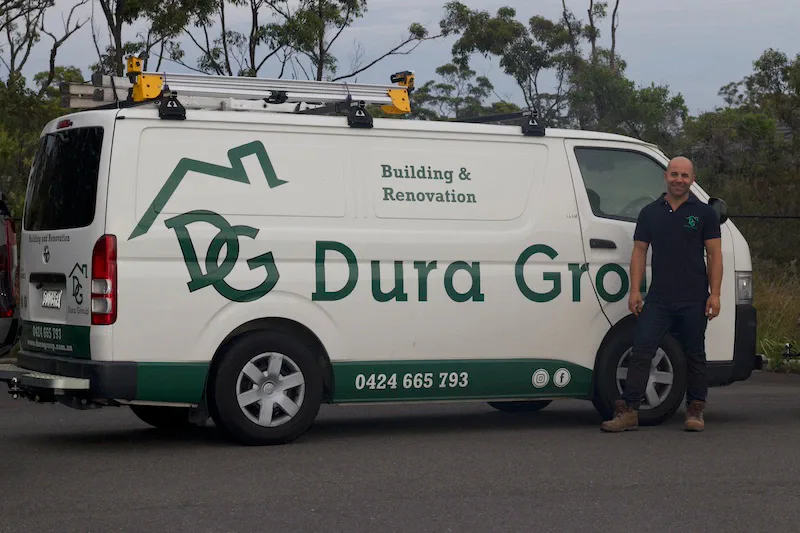
At Dura Group Building & Renovations, we work with trusted architects and building designers on projects that require a full DA or where the brief is architecturally complex. On more straightforward CDC-eligible rear extensions, we can manage the design and approval process directly, which simplifies the process for the homeowner and keeps communication in one place. Mark personally oversees every project from the initial site visit through to completion.
Where has Dura Group completed rear extensions in Sydney?
We have worked on rear extensions across the Inner West and Georges River area, including terraces in Marrickville and Newtown, bungalows in Leichhardt and Haberfield, and older homes in Oatley and Hurstville Grove.
If you are based in these areas, our suburb pages provide more specific information about working in your location:
- Builders in Marrickville
- Builders in Leichhardt
- Builders in Newtown
- Builders in Oatley
- Builders in Hurstville
We understand the site conditions, council requirements, and access challenges that come with working in these areas. That local knowledge is part of what we bring to every project, along with fixed lump sum pricing and no hidden costs.
If your home is two-storey or you are considering going up rather than out, our Second Storey Extension Guide covers the alternative approach.
For more about how we can help, visit our house extension services page.
Ready to start planning your rear extension?
If you are thinking about extending at the rear, the best first step is a conversation with Mark. Get in touch with Dura Group Building & Renovations for a consultation. We work across the Inner West and Georges River area and would be glad to walk through your site, your brief, and your options with you.

Mark Dura is the founder of Dura Group Building & Renovations, a licensed builder (Lic 381531C) with 27+ years of experience in residential renovations, home extensions, and knockdown rebuilds across Sydney. Mark oversees every project from design through to completion.