Waterproofing is the single most important step in any bathroom renovation. Get it wrong and you face structural damage, mould growth, and repairs that cost far more than the original job. In NSW, waterproofing is governed by Australian Standard AS 3740, which sets out exactly where membranes must be applied, how they must be installed, and who can certify the work. Bathroom renovation costs can escalate quickly when waterproofing failures are discovered during a project, so understanding this process upfront saves time and money.
At Dura Group Building & Renovations, we have completed over 1,000 bathrooms across the Sutherland Shire and Georges River regions. Many of these projects involve stripping back failed waterproofing in older homes, particularly fibro and brick cottages built before membrane systems became standard in the 1990s. This guide explains what NSW law requires, what it costs, and why professional installation matters.
What does AS 3740 require for bathroom waterproofing in NSW?
AS 3740 is the Australian Standard that mandates waterproof membranes in all wet areas, including showers, bathroom floors, and laundries. In NSW, compliance with this standard is enforced through the National Construction Code (NCC) and is a condition of any building certification. The standard specifies membrane types, application methods, bond strength, and the minimum areas that must be covered.
For homeowners, the practical meaning is straightforward: every surface that can get wet must be protected by a continuous, tested membrane system. This is not optional. A certifier must inspect the waterproofing before tiling begins, and if it fails inspection, the membrane must be removed and reapplied.
Which areas must be waterproofed under AS 3740?
Showers (floor and walls to a minimum 1,800mm height), the entire bathroom floor, around baths, and laundry floors all require waterproof membranes. The specific requirements include:
- Shower recesses: floor and walls to at least 1,800mm above the finished floor level, extending 150mm beyond the shower screen
- Bathroom floors: the entire floor area outside the shower, including under the vanity and toilet
- Around baths: the floor beneath and 150mm up the wall where the bath meets the wall
- Above baths with a shower: walls to 1,800mm from the bath rim
- Laundry floors: the entire floor area where a washing machine, tub, or floor waste is present
If you are renovating your laundry alongside a bathroom, the waterproofing scope expands to cover both wet areas. Understanding laundry renovation costs helps you budget for the additional membrane work.
What types of waterproofing membrane are used in bathrooms?
Two main membrane types are used in residential bathrooms: liquid-applied membranes and sheet membranes, with liquid-applied being the most common in NSW renovations.
How do liquid-applied membranes work?
Liquid-applied membranes are painted or rolled onto surfaces in two coats, forming a continuous rubber-like layer once cured. They are preferred for most bathroom renovations because they conform to irregular surfaces, corners, and penetrations (such as pipe holes and floor wastes). Popular brands in the Australian market include Ardex, Mapei, and Davco. Each coat must dry before the next is applied, and the total dry film thickness must meet the manufacturer’s specifications, typically 1mm to 1.5mm.
The advantage of liquid membranes is their ability to wrap around junctions and penetrations without joins. Every join in a membrane is a potential failure point, so fewer joins means lower risk.
When are sheet membranes the better choice?
Sheet membranes are pre-formed rolls of polyethylene or modified bitumen, bonded to surfaces with adhesive or heat. They are commonly used on large, flat floor areas or where higher chemical resistance is needed (for example, in commercial wet areas). In residential bathrooms, sheet membranes are sometimes used on concrete slab floors before a screed is laid. They are less practical on walls and around penetrations because each overlap and termination must be sealed with tape or welded.
How much does bathroom waterproofing cost in Sydney?
Waterproofing a single wet area typically costs between $1,000 and $3,000, depending on the room size, substrate condition, and membrane system used. This includes surface preparation, priming, membrane application (two coats minimum), reinforcing tape at internal corners and junctions, and certification inspection.
Cost factors that push the price toward the higher end include:
- Removing existing failed membranes or damaged substrates
- Repairing cracks or movement joints in concrete slabs
- Larger rooms with more penetrations (dual shower heads, multiple floor wastes)
- Waterproofing above ground-floor level, where consequences of failure are more severe
These costs are a fraction of what you pay to rectify water damage later. Failed waterproofing in a first-floor bathroom can cause ceiling collapse in the room below, damage to timber framing, and mould that requires specialist remediation. When planning your project, be aware of the hidden costs that surface when older waterproofing is found to be compromised during demolition.
Why does DIY waterproofing fail?
DIY waterproofing fails because homeowners underestimate the precision required in surface preparation, membrane thickness, and drying times. The most common DIY mistakes include:
- Applying membrane over dusty, damp, or unprimed surfaces, preventing proper bond
- Applying coats too thin (a single brush coat rarely meets the required 1mm dry film thickness)
- Not reinforcing internal corners and floor-to-wall junctions with tape or bandage
- Tiling over membrane before it has fully cured, trapping moisture underneath
- Missing areas that are required under AS 3740, such as under the vanity or behind the toilet
In NSW, DIY waterproofing also creates a compliance issue. A licensed waterproofer must provide a certificate of compliance for the membrane, and a building certifier must inspect it before tiling. Without these documents, you cannot obtain a compliant occupation certificate for a renovation. If you later sell the property, missing waterproofing certificates can become a legal liability.
What certification is required for waterproofing in NSW?
NSW requires that waterproofing be installed by a licensed tradesperson and inspected by a principal certifying authority (PCA) before any tiling begins. The waterproofer must hold a specific licence class issued by NSW Fair Trading. They provide a manufacturer’s warranty and a compliance certificate that confirms the membrane meets AS 3740.
The PCA then inspects the membrane at the “pre-tile” stage. This inspection checks membrane coverage, thickness, continuity around penetrations, and correct termination heights on walls. If it fails, the membrane must be rectified and reinspected before work continues. This is a non-negotiable step in the building process, and skipping it invalidates your building approval.
Understanding whether your renovation is structural vs cosmetic determines your certification pathway. Waterproofing always falls under structural requirements, even in what might appear to be a simple cosmetic refresh.
How does Dura Group handle waterproofing?
We use licensed waterproofing specialists on every project and schedule the PCA inspection before any tiling begins, so there is never a question about compliance. Our process follows a clear sequence:
- Demolition and substrate assessment: we check the existing slab or floor sheeting for cracks, movement, and moisture
- Repairs: any cracks are routed and filled, and damaged sheeting is replaced with fibre cement board rated for wet areas
- Priming: the substrate is primed to ensure proper membrane adhesion
- First membrane coat: applied by our licensed waterproofer with reinforcing tape at all internal angles and penetrations
- Second membrane coat: applied in a contrasting colour so full coverage is visible
- Flood testing (where applicable): the shower or floor is filled with water and left for 24 hours to confirm no leaks
- PCA inspection and sign-off
- Tiling begins only after written approval
Because we coordinate all trades in-house, there are no gaps between the waterproofing and tiling stages. Materials and trades are ready before we start, which means the membrane is not left exposed and vulnerable to damage from other site work. This is part of our commitment to lump sum pricing with no hidden costs, and it keeps your project moving without delays.
What are common waterproofing failures in older homes?
Homes built before the mid-1990s often have no waterproofing membrane at all, relying instead on lead or copper shower pans and tile grout alone to contain water. These older systems fail in predictable ways:
- Cracked grout allows water to penetrate behind tiles and into the substrate
- Lead shower pans corrode and develop pinholes over 30 to 40 years
- Timber floors beneath bathrooms rot from prolonged moisture exposure
- Asbestos-containing fibre cement sheeting (common in pre-1990 builds) deteriorates when wet
- Concrete slabs develop cracks from settling, and without a flexible membrane, water tracks through
Across the Sutherland Shire, particularly in suburbs like Sylvania, Caringbah, and Sans Souci, many homes were built in the 1960s and 1970s. These brick-and-tile or fibro homes have bathrooms that have never been waterproofed to modern standards. When we strip back tiles in these properties, we commonly find black mould through the wall framing and deteriorated floor sheeting that requires full replacement before new waterproofing can be applied.
Homes along the Georges River corridor face additional challenges. Higher ambient humidity and proximity to water mean that any waterproofing weakness is exploited faster. We have completed projects in Sans Souci and Sylvania where bathroom leaks had caused structural damage to floor joists that went undetected for years.
If you are considering a renovation in the area, our team of Sylvania builders and Sans Souci builders can assess your existing waterproofing during a site inspection. We also work with homeowners across the Shire, including those seeking builders in Caringbah and surrounding suburbs.
How do you know if your existing waterproofing has failed?
Signs of waterproofing failure include bubbling or lifting tiles, musty odours, damp patches on walls or ceilings below a bathroom, and visible mould around the shower base. Other indicators include:
- Grout that stays damp or darkens persistently
- Paint peeling on the ceiling of the room below the bathroom
- Skirting boards swelling or warping near the bathroom
- A spongy feel underfoot near the shower or bath
If you notice any of these signs, the issue is unlikely to resolve itself. Water damage is progressive. The longer it continues, the more extensive (and expensive) the repair becomes. Early intervention often means replacing only the waterproofing and tiling, while delayed repairs can require new floor framing, wall sheeting, and even structural work. Understanding building costs helps you plan for these scenarios before they escalate.
What should you budget for waterproofing in a full renovation?
Waterproofing should represent roughly 5 to 10 percent of your total bathroom renovation budget, depending on the condition of the existing substrate. For a standard bathroom renovation in Sydney, where home renovation costs vary by scope and complexity, waterproofing is one line item that should never be reduced to save money.
A properly installed membrane system will last the lifetime of the bathroom, typically 15 to 25 years until the next renovation. A failed membrane can cost $10,000 to $20,000 or more to rectify once you account for demolition, structural repairs, new waterproofing, tiling, and fixtures.
When Dura Group provides a fixed lump sum quote for your bathroom renovation services, waterproofing is always included as a separate line item. You can see exactly what you are paying for, and it is never cut to make a quote look cheaper.
Ready to start your bathroom renovation?
If your bathroom is showing signs of waterproofing failure, or you are planning a renovation and want it done right from the start, we are here to help. Dura Group works with homeowners across the Sutherland Shire and Georges River to deliver bathrooms that are properly waterproofed, fully certified, and built to last. Get in touch for a quote and let’s create a space you’ll love coming home to.

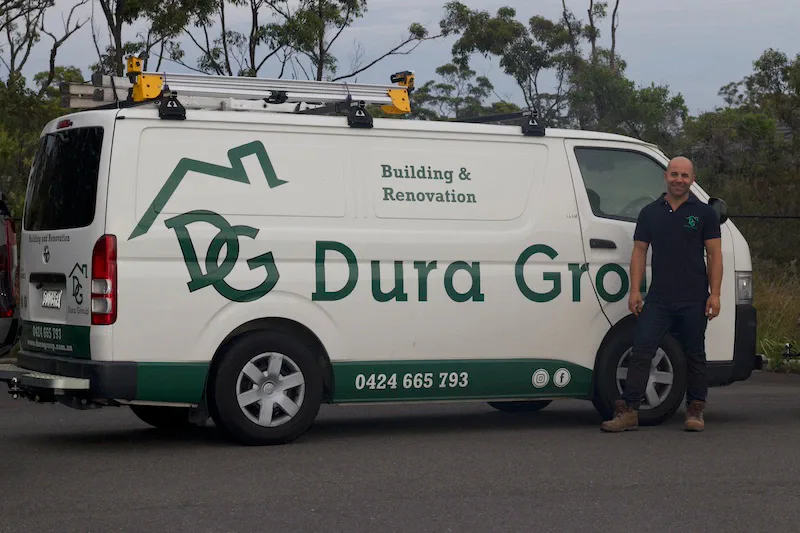
Mark Dura is the founder of Dura Group Building & Renovations, a licensed builder (Lic 381531C) with 27+ years of experience in residential renovations, home extensions, and knockdown rebuilds across Sydney. Mark oversees every project from design through to completion.