Fibro homes are renovated every week across Sydney, and with the right builder and a clear plan, they can be transformed into comfortable, modern homes. The key is understanding what fibro homes contain, where asbestos is likely to be, and what that means for your renovation scope and budget before any work begins. This guide walks you through everything you need to know – from fibro cottages in Jannali to post-war homes in Peakhurst and everything in between.
What is a fibro home?
A fibro home is a house clad in asbestos cement sheeting, a building material that was widely used across Australia from the 1940s through to the late 1970s. “Fibro” is short for fibrous cement, and for decades it was the go-to material for affordable housing. It was cheap to produce, easy to cut and install, and resistant to moisture and fire. Thousands of homes across the Sutherland Shire and Georges River council areas were built using it.
The sheeting typically appears on external walls, internal partition walls, eaves, soffits, wet area linings, and sometimes under flooring. In homes built between roughly 1940 and 1960, the cement product almost always contains chrysotile (white asbestos) or amosite (brown asbestos). Homes built after 1980 may still have fibro sheeting, but it is generally asbestos-free. If your home was built before 1985, it should be treated as if it contains asbestos until proven otherwise.
Where are fibro homes most common in Sydney?
Fibro homes are particularly concentrated in the Sutherland Shire and Georges River area, where post-war housing estates were built rapidly to house Sydney’s growing population through the 1940s, 1950s, and 1960s. These were working-family suburbs, developed quickly and affordably, and fibro was the material that made it possible.
In the Sutherland Shire, you will find fibro cottages throughout Jannali, Gymea, Gymea Bay, Loftus, Engadine, Kirrawee, and Como. Many of these sit on generous 600 to 900 square metre blocks, some backing directly onto bushland near the Royal National Park. Across the Georges River council area, fibro homes are common in Peakhurst, Carlton, Mortdale, Riverwood, and Banksia, where the suburb layouts reflect the same post-war planning approach.
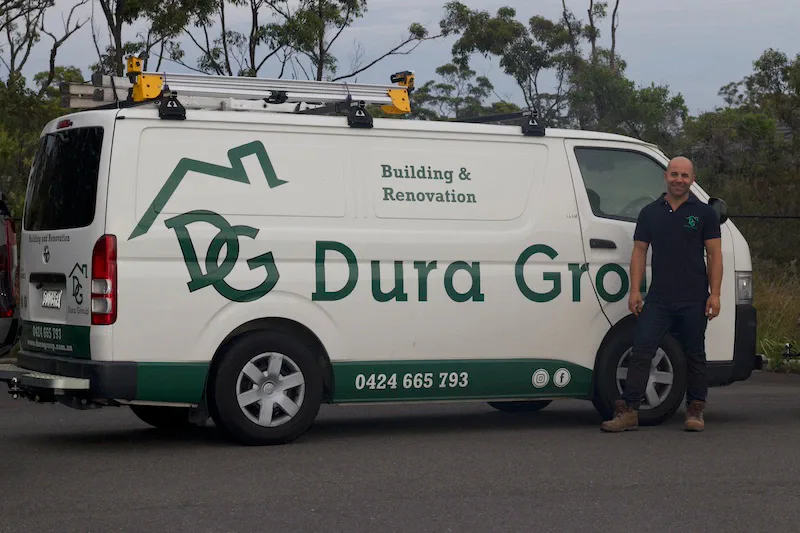
At Dura Group Building & Renovations, we have completed projects across both council areas for many years. We know these streets, these blocks, and these homes. That local knowledge matters when you are planning a renovation that involves asbestos materials and structural upgrading.
If you are looking for builders in Jannali, builders in Gymea, or builders in Loftus, we service all of these areas directly.
Is asbestos in a fibro home dangerous?
Bonded asbestos cement sheeting, which is what most fibro homes contain, is considered low-risk when it is in good condition and left undisturbed. The asbestos fibres are locked into the cement matrix. As long as the sheeting is intact and not crumbling, friable, or being cut, drilled, or sanded, it does not release fibres into the air.
The risk rises sharply once work begins. Any renovation that cuts, breaks, or disturbs asbestos cement sheeting must follow strict WorkSafe and SafeWork NSW guidelines. That means engaging licensed asbestos removal contractors, following correct containment procedures, and disposing of waste through approved facilities. This is not optional, and any reputable builder will insist on it.
For a detailed look at how asbestos affects renovation planning across Sydney, see our guide to asbestos in Sydney homes.
Where exactly is asbestos found in a fibro home?
In a typical fibro home, asbestos cement sheeting can appear in six or more locations throughout the building. Knowing where to look before you plan any work is what separates a smooth renovation from a costly surprise mid-project.
Common locations include:
- External wall cladding – the most visible use of fibro, often painted over multiple times
- Internal partition walls – particularly in older floor plans where the wall framing was lined with flat fibro sheet
- Eaves and soffits – almost universally asbestos cement in pre-1980 homes
- Bathroom and laundry linings – fibro was used as a wet-area lining before modern tile backer boards existed
- Under floor coverings – vinyl floor tiles and the adhesive (black mastic) used with them often contained asbestos, as did fibro sheeting used as a subfloor layer
- Fencing and outbuildings – garages, sheds, and old fencing on the property may also contain asbestos cement
A pre-renovation asbestos inspection by a licensed assessor is the starting point for any fibro renovation. The inspection produces an asbestos register and a clearance report that your builder works from. We coordinate this process for our clients as part of the pre-build planning phase.
How much does it cost to renovate a fibro home?
Fibro home renovations typically cost more than equivalent brick or timber-frame projects, because asbestos removal, structural inspection, and often restumping, rewiring, or replumbing are required before cosmetic work can begin. The cost depends on the scope of asbestos, the structural condition of the home, and what you want to achieve at the end of the project.
For a full picture of renovation budgeting in Sydney, our guide to how much a home renovation costs covers the key cost drivers across project types. For a breakdown of what goes into Sydney construction costs broadly, see our building costs in Sydney guide.
A few cost factors are specific to fibro homes:
- Asbestos removal – licensed removal, disposal, and clearance inspections add cost to every phase that involves disturbing sheeting. This is non-negotiable.
- Restumping – many fibro homes were built on timber stumps that are now 60 to 80 years old. Replacing them with concrete or steel piers is often required before anything else happens.
- Rewiring – electrical systems from the 1950s and 1960s rarely meet current standards. A full rewire is common in renovations of this era.
- Replumbing – lead-jointed or galvanised iron pipe systems need replacement. Drainage may also need upgrading to meet council requirements.
- Insulation – original fibro walls contain no insulation. Adding it once the sheeting is removed is the right time to address energy efficiency.
- Re-cladding – once fibro sheeting is removed, the external walls need a new cladding material. Fibre cement (modern, non-asbestos) is the most common replacement and blends well with the original aesthetic.
These hidden costs are predictable when you do a proper structural assessment before work begins. Our article on the hidden costs of renovating explains what to watch for when scoping any older home.
What does a fibro home renovation typically involve?
A fibro renovation usually goes well beyond cosmetic changes, because the structural and services condition of the home needs attention before any finishes are applied. This is the most important thing for owners to understand going in: the scope is almost always larger than it first appears.
A typical project might follow this sequence:
- Pre-renovation asbestos inspection and register
- Structural assessment (stumps, bearers, joists, frame)
- Licensed asbestos removal of sheeting in the work area
- Restumping and subfloor repairs if required
- Electrical and plumbing upgrades
- Re-framing or opening walls where layout changes are planned
- Installation of insulation
- New wall linings (plasterboard internally, fibre cement or comparable externally)
- Wet area waterproofing and tiling
- Kitchen and bathroom fitout
- Painting, flooring, and finishing
For a broader overview of how a building project progresses from planning through to completion, see the home building process guide.
Understanding the difference between cosmetic and structural work is also useful when planning scope. Our guide to structural vs cosmetic renovation explains when you are dealing with surface changes versus work that affects the fabric of the building.
Should you renovate or rebuild a fibro home?
The choice to renovate or rebuild depends on the structural condition of the home, your budget, and what you want the finished result to look like. There is no single right answer, and we always recommend a proper structural assessment before making that call.
Renovation is generally the better path when:
- The frame, stumps, and structure are sound after inspection
- The asbestos content is primarily bonded sheeting (not friable or heavily degraded)
- You want to retain the character or layout of the existing home
- The block orientation and existing footprint suit your needs
A knockdown rebuild is worth considering when:
- The structural condition is poor and the scope of repairs is extensive
- You want a completely different layout or a significantly larger home
- The asbestos extent is widespread and the cost of removal approaches or exceeds demolition cost
- The block is large enough to justify a new build (many Shire blocks are well suited)
Our guide to whether it is cheaper to renovate or rebuild breaks down the financial comparison in detail. If a knockdown rebuild is on the table, knockdown rebuild costs in Sydney gives you a realistic picture of what that path involves.
Do you need council approval to renovate a fibro home?
Most renovations to fibro homes in the Sutherland Shire and Georges River council areas require either a Development Application (DA) or a Complying Development Certificate (CDC), depending on the scope of work. Asbestos removal on its own has separate licensing and notification requirements under SafeWork NSW, regardless of planning approvals.
Internal cosmetic work is often exempt development, but structural changes, additions, or external re-cladding usually require approval. We handle DA and CDC applications directly for our clients and are familiar with the requirements under both Sutherland Shire Council and Georges River Council. If you are looking for builders in Peakhurst or builders in Carlton, we are across the local planning controls for those suburbs.
Our guide to renovating in the Sutherland Shire covers the local approval process in more detail, and building in the Georges River area addresses the equivalent requirements for that council.
Why is a structural assessment so important before quoting?
A structural assessment before quoting protects both the homeowner and the builder from cost blowouts mid-project. Fibro homes from the 1940s to 1960s are now 60 to 80 years old. What looks cosmetically rough on the outside can sometimes reveal sound bones once inspected. The reverse is also true: a tidy-looking home can have rotted stumps, deteriorated bearers, or subfloor moisture damage that is not visible until work begins.
At Dura Group Building & Renovations, Mark personally inspects every project before a quote is produced. That means we are quoting on reality, not assumptions. Our lump sum pricing is based on what we find during that initial walkthrough. We do not add items to your invoice mid-project because we did not look properly at the start.
We have completed renovations across Engadine, Kirrawee, Gymea Bay, Jannali, Peakhurst, Mortdale, and throughout the surrounding suburbs. We know what these homes typically contain, what condition they are in, and how to price them accurately.
Is it worth renovating a fibro home?
Yes, and fibro homes are renovated every day across Sydney to a very high standard. The process requires proper planning, licensed trades, and a builder who understands what is involved, but none of it is unusual or out of reach.
Many of the best-value renovation projects we complete are fibro homes. The large blocks common in the Sutherland Shire give you space to extend or improve outdoor areas. The suburb locations, particularly in Gymea, Jannali, Loftus, and Engadine, are desirable. And the homes themselves, once updated and re-clad, perform well and hold value.
The critical step is not rushing into a quote without a structural inspection and asbestos assessment. Go in with clear information, understand the scope, and work with a builder who has done this before. That is where it comes together.
For more about how we can help, visit our Dura Group renovation services page.
Ready to start your fibro home renovation?
If you own a fibro home in the Sutherland Shire or Georges River area and you are thinking about renovating, we are happy to walk through the property with you. Contact Dura Group Building & Renovations for an initial consultation with Mark. We will tell you honestly what is involved, what it is likely to cost, and whether renovation or a knockdown rebuild makes more sense for your situation.

Mark Dura is the founder of Dura Group Building & Renovations, a licensed builder (Lic 381531C) with 27+ years of experience in residential renovations, home extensions, and knockdown rebuilds across Sydney. Mark oversees every project from design through to completion.